29 . 10 . 2026
AI Governance for Businesses: What to Control Before Scaling
AI governance for businesses: discover five key controls to protect data, manage access, and oversee the use of artificial intelligence.
Table of contents
- The challenge of governing AI that is already in use
- Five controls for governing AI use in businesses
- How to determine whether an AI use case can be approved
- From policy to technical controls: what Google Cloud offers in 2026
- Where to start implementing AI governance
- FAQs about AI governance for businesses
- Governing AI means building decision-making capabilities
AI governance for businesses becomes necessary when different departments begin using assistants to summarize commercial documents, analyze customer information, or automate tasks without a clear understanding of how these tools are being used.
These initiatives can improve productivity, but they raise questions that many organizations still cannot answer: Which tools are being used? What information are users sharing? Who authorizes and oversees their use?
The challenge is not only to control internally developed solutions but also to establish the conditions for adopting artificial intelligence without compromising security, traceability, or control over corporate information. Below, we explain how you can establish AI governance in your organization.
The challenge of governing AI that is already in use
AI governance encompasses the policies, responsibilities, and mechanisms needed to oversee its adoption and manage associated risks.
One of the challenges is shadow AI: the use of artificial intelligence tools without the knowledge or authorization of those responsible for IT.
Google Cloud warns that these practices can create security blind spots, especially when employees share corporate information with external services.
In this context, the objective is to transform fragmented AI usage into a managed practice, where each solution has a defined purpose, designated owners, and controls proportionate to its risks.
Five controls for governing AI use in businesses
Effective AI governance for businesses requires specific controls to identify risks, define responsibilities, and oversee the use of artificial intelligence.
1. Identify tools, users, and owners
The first step is to understand which solutions each department uses and for what tasks.
An inventory should record, at a minimum:
- Tool and provider.
- Department using the tool and its designated owner.
- Purpose or use case.
- Type of information processed.
- Authorization status.
This information can be gathered through internal assessments, reviews of contracted applications, and capabilities that provide visibility into web service usage.
The control will be effective when identified use cases have a designated owner and a documented authorization decision, not simply when a list of tools exists.
2. Classify data and assess its exposure
Using public information to generate content does not present the same risk as sharing contracts, personal data, or financial documents.
Before approving a solution, organizations need to assess data classification, the provider’s terms, data storage, retention, and potential use for model training.
Restrictions must also be defined regarding what information can be transferred. Data loss prevention (DLP) mechanisms can reduce certain exposures, provided they cover the channels being used and are properly configured.
This assessment requires an established foundation of data governance in IT operations to understand how corporate information is classified, protected, and monitored.
The effectiveness of the control must be verified through testing of restrictions and reviews of authorized exceptions.
For example, in 2026, Google Cloud introduced IAM Data Governance Tags for BigQuery, a capability that allows sensitive columns to be classified using hierarchical tags and differentiated access or masking policies to be applied. This enables an organization to define which users can access original data and which can only access protected versions.
3. Evaluate and authorize each use case
Approving a tool does not mean authorizing all its possible applications.
A platform may be suitable for drafting commercial content but require additional controls when used to analyze confidential information or support critical decisions.
Therefore, the assessment must consider the impact of incorrect results, the data involved, integrations, and the need for human oversight.
The outcome should be documented as approved, conditionally approved, or unauthorized use, including who made the decision and when it should be reviewed.
4. Define identities, permissions, and restrictions
Governance must also establish who can access each solution and which resources they can use.
Where supported by the platform, organizations should implement corporate authentication, MFA, and permissions based on the principle of least privilege.
Integrations with email, repositories, applications, or internal systems require particular care. These integrations can provide the tool with access to additional information and actions.
This approach is related to the Zero Trust model applied to IT infrastructure, which requires access to be verified based on identity, context, and necessary privileges rather than granting trust by default.
Reviewing active permissions and removing unnecessary access helps verify whether restrictions remain appropriate.
5. Audit usage and measure effectiveness
Having policies in place does not guarantee compliance.
Organizations need to review activity, exceptions, incidents, and evidence that controls are being applied.
Some useful indicators include:
- Inventoried and assessed use cases.
- Access permissions pending review.
- Blocked information transfers.
- Open exceptions and corrective actions.
There is an additional precaution: audit logs themselves may contain prompts, responses, or references to sensitive documents. Therefore, they must also be protected with appropriate permissions and retention policies.
As with other cybersecurity controls, the difference lies between having a measure configured and demonstrating that it works against the risk it is intended to reduce.
Is your strategy ready to incorporate AI without losing control?
Download the guide Google Cloud 2026: 5 Keys to an AI-Ready Architecture and explore the five areas to evaluate before scaling.
How to determine whether an AI use case can be approved
To turn these controls into decisions, we recommend assessing each initiative based on three factors: how sensitive the information is, what impact it could have, and which controls are available.
| Assessment Question | Measure to Consider |
| Does it process confidential information or personal data? | Review data handling practices and provider guarantees |
| Does it connect to internal applications? | Assess integrations, identities, and permissions |
| Could its results affect critical decisions? | Establish human validation and acceptance criteria |
| Can its activity be audited? | Verify logs, designated owners, and monitoring mechanisms |
This matrix is intended as a guide and should be adapted to each organization’s obligations and risks.
For example, an assistant may be approved to summarize public information. It may also require an additional assessment before analyzing customer contracts.
The difference is not the tool itself, but the risk associated with the use being authorized.
From policy to technical controls: what Google Cloud offers in 2026
Defining rules is necessary, but they must be translated into mechanisms that can be applied and verified.
Google Cloud documents two complementary approaches.
1. Prevention of information exposure
Chrome Enterprise Premium includes DLP capabilities. These make it possible to restrict certain copy-and-paste operations, mask sensitive information, and apply controls to external AI tools.
In September 2026, Google also described improvements to visibility into AI and SaaS application usage through the browser, including options to block risky services or direct users toward approved alternatives.
2. Auditing and adoption analysis. For Gemini Enterprise
Google Cloud introduced a methodology using Cloud Logging, Log Router, and BigQuery to collect and analyze activity, access, and usage patterns.
This architecture makes it possible to go beyond interaction volume: teams can analyze which departments use assistants, which corporate data sources they access, and which events require a security review. This information can be used to detect unintended uses, investigate alerts, and adjust access policies.
An important technical consideration: Data Access logs must be explicitly enabled. In addition, the information collected may include prompts and responses, so it requires its own access controls.
These capabilities have different scopes. Browser visibility does not necessarily cover every application or integration, while Gemini Enterprise logs apply to its managed environment.
The lesson is that implementing monitoring technology is not the same as establishing AI governance. The organization must still define who reviews the evidence, which situations require intervention, and how deviations are corrected.
Where to start implementing AI governance
A company already using AI does not need to start with a complex structure, but rather with an assessment that helps organize decisions.
The process can be organized into three stages:
- Identify existing uses.
- Prioritize risks.
- Implement controls with ongoing monitoring.
The difficulty often lies in coordinating these responsibilities. Security teams may identify an exposure, IT may manage access, and business departments may define the criticality of a process. Without a shared perspective, these measures can become disconnected.
Furthermore, when an organization develops its own solutions or uses AI in critical processes, this governance model must be connected to an operationally ready enterprise AI architecture. This architecture must be capable of supporting integrations, security, and daily operations.
At Wezen, we approach this challenge with a comprehensive perspective on infrastructure, cloud, and cybersecurity. Through capabilities such as cybersecurity assessments and strategic vCISO support, we help organizations identify gaps, prioritize risks, and define controls aligned with their operations.
The value of a technology partner lies not only in implementing tools, but also in connecting decisions about data, access, and security with a strategy that can be sustained as AI usage evolves.
FAQs about AI governance for businesses
Do “AI governance” and “governance of AI” mean the same thing?
In a business context, these terms are generally used interchangeably. Both encompass policies, responsibilities, and controls for managing the use of artificial intelligence.
Does a company that only uses third-party AI tools need governance?
Yes. Even if it does not develop models, it must evaluate what information it shares, how that information is processed, and what risks the results may create.
What should be evaluated before approving an AI tool?
The use case, provider, data sensitivity, required permissions, and available oversight mechanisms.
Who should lead AI governance?
There should be formal accountability and coordination among IT, security, business departments, and executive management, depending on the organization’s structure.
How can the effectiveness of AI controls be measured?
Through compliance testing: assessed use cases, reviewed access permissions, detected incidents, managed exceptions, and verified corrective actions.
Governing AI means building decision-making capabilities
The challenge for businesses is not only to control the tools they use today, but also to prepare to evaluate those they will adopt tomorrow.
Effective AI governance enables consistent decisions about technologies, data, access, and risks. This way, each new initiative does not become an exception.
The goal is not to restrict innovation, but to create the conditions for it to scale with control, security, and confidence. And that requires integrating AI governance with the technology strategy and the real needs of the business.
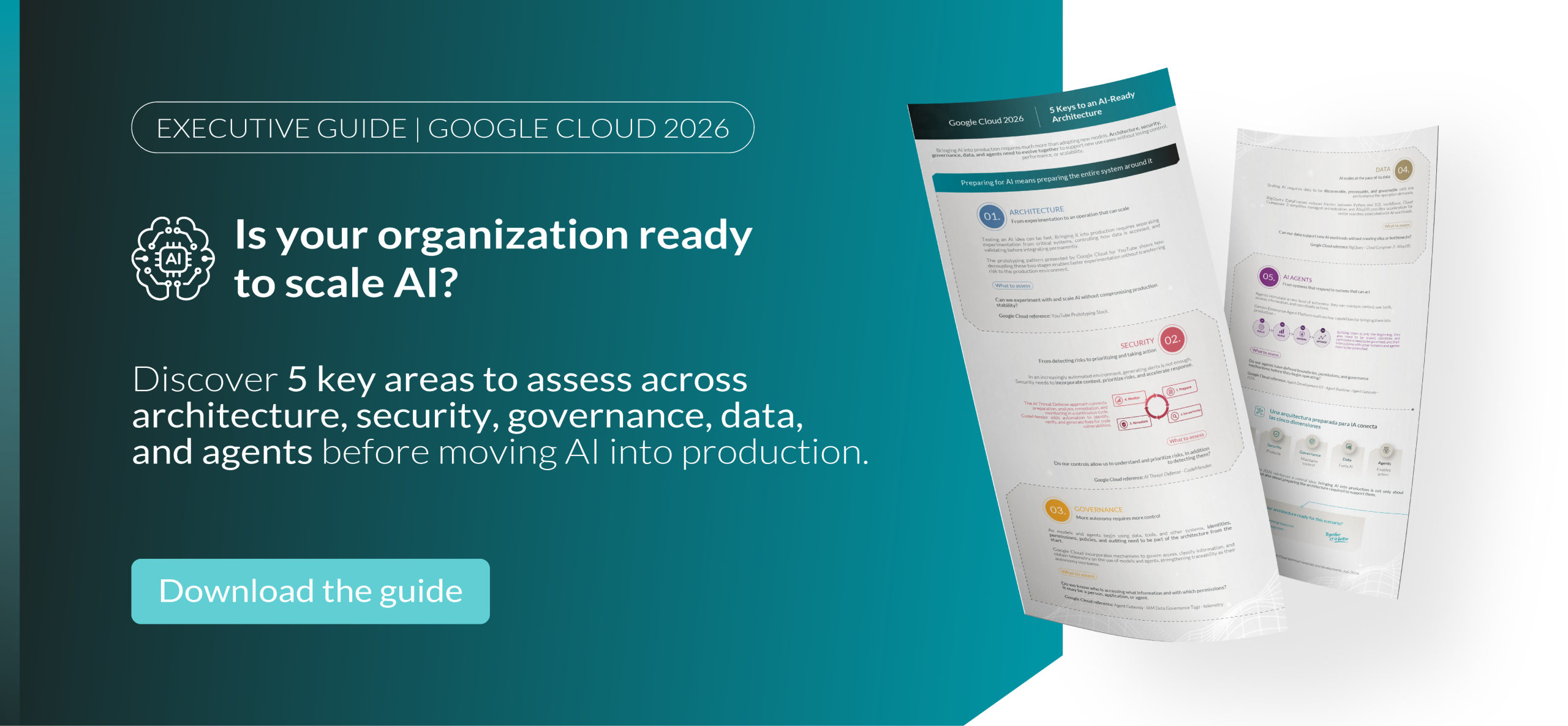

Image: Image generated with ChatGPT Images 2.5, OpenAI, 2026.
Sources Consulted
- Berschadski, M. (2026, January 28). Future Mode Part 1: The intelligent and secure browser for enterprises. Google Cloud Blog. URL
- Rajamani, V., & Busam, P. (2026, July 17). Level up your column-level security: Using IAM data governance tags in BigQuery. Google Cloud Blog. URL
- Cunningham, N. (2026, October 1). The future of browser-based security: Leveraging browser data for proactive defense. Google Cloud Blog. URL
- Prabhat, A., & Guha, S. (2026, July 15). How to analyze and govern Gemini Enterprise app usage at scale with BigQuery. Google Cloud Blog. URL
- Still, D., & Berschadski, M. (2026, September 23). Secure, intelligent experiences across every endpoint. Google Cloud Blog. URL
Related articles

Security for SAP, why does Fortinet offer comprehensive protection in the cloud?
Find out what is the importance of ensuring security for SAP and six Fortinet use cases for SAP.
Hybrid infrastructure in 2025: trends and challenges for enterprises.
Discover the trends and challenges of hybrid infrastructure in 2025. Security, scalability, and efficiency for the digitization of your company.