27 . 08 . 2026
Cybersecurity Controls: How to move beyond a checklist to an effective defense
Discover how to prioritize, test, and manage cybersecurity controls to reduce real risks and strengthen the protection of your operations.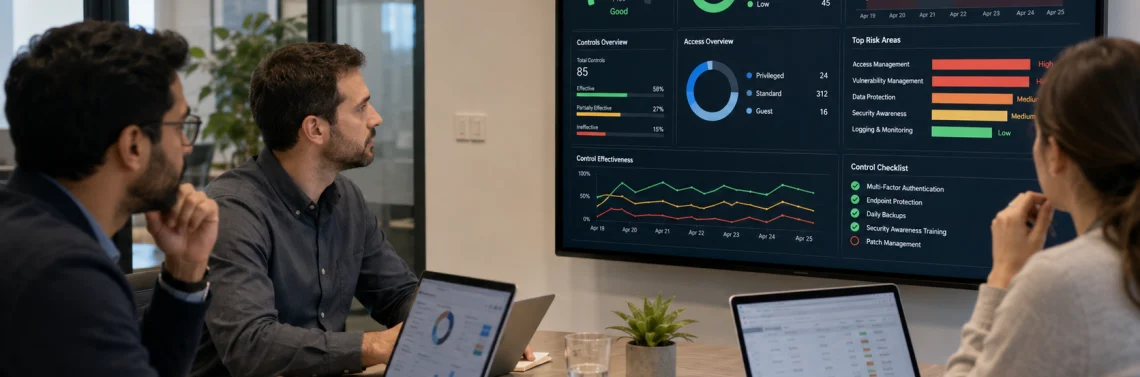
Table of contents
- What Are Cybersecurity Controls and What Should They Protect?
- More controls do not necessarily mean greater security
- 5 Conditions for an effective cybersecurity control
- How to prioritize controls without turning security into an endless list
- How to tell if controls are actually working
- From isolated controls to a manageable security posture
- When is it a good idea to conduct a cybersecurity controls assessment?
- FAQ About cybersecurity controls
- Controls must hold up in practice
An organization may have dozens or even more than a hundred documented cybersecurity controls and still be vulnerable. The problem arises when those controls become a mere administrative requirement: they exist, but they aren’t prioritized based on risk, there are no clear points of responsibility, and no one can demonstrate whether they work.
In 2026, this distinction is even more critical. Verizon’s Data Breach Investigations Report indicates that 31% of breaches began with the exploitation of vulnerabilities, which surpassed the use of stolen credentials as the primary point of entry for the first time.
How can we move from a catalog of controls to a manageable security posture? In this article, we examine the conditions that allow us to prioritize these controls, integrate them into operations, and verify their effectiveness. The key question is not how many controls exist, but what risk each one mitigates and how that can be demonstrated.
What Are Cybersecurity Controls and What Should They Protect?
Cybersecurity controls are technical, organizational, or process-based measures designed to reduce risks to assets, identities, data, applications, and critical operations. They may include MFA, hardening, segmentation, access policies, backups, monitoring, or response procedures.
Their value does not lie in simply meeting a requirement. A control should address a specific risk scenario and protect a business-critical outcome: availability, confidentiality, operational continuity, or resilience.
In practice, there are three distinct levels: having a control, implementing it correctly, and demonstrating that it is effective.
More controls do not necessarily mean greater security
An extensive catalog loses its value if no one can answer which risk each control addresses, who is responsible for maintaining it, and what evidence confirms that it continues to function.
CIS follows a similar logic. Its Controls Assessment Specification states that it is not enough to simply implement safeguards: it is also necessary to measure their implementation. Its Implementation Groups also allow controls to be prioritized according to each organization’s risk profile and available resources.
The problem becomes harder to detect when controls are spread across different departments. Identity manages access, Infrastructure manages the cloud and networks, Security analyzes alerts, and Risk consolidates information.
Each control can function separately and still leave gaps at the points of connection. Fragmentation doesn’t always mean that controls are missing. Often, it means that no one can see how they work together.
5 Conditions for an effective cybersecurity control
A control adds value when it reduces a specific exposure and can be sustained over time. To achieve this, five conditions must work together.
1. Prioritize based on risk and business impact
Not all controls require the same level of urgency. Prioritization should begin with the assets and processes whose compromise could have the greatest operational, financial, or regulatory impact.
The logic is simple:
critical asset → risk scenario → necessary control → priority action
This way, resources are focused where exposure can be reduced the most, rather than mechanically following a framework.
2. Define Clear Owners
Every control needs an owner. This could be Security, Infrastructure, Networking, Applications, Human Resources, or a vendor, depending on the situation.
The important thing is to know who implements it, who reviews exceptions, who generates evidence, and who takes action in the event of a deviation.
When responsibility is assigned to “IT” or “everyone,” the control can deteriorate without anyone directly responsible for detecting and correcting it.
3. Integrate It into daily operations
Effective security controls must function while the company is operating, not just when an audit is approaching.
User onboarding and offboarding, privileges, patches, configuration changes, backups, and monitoring need to be integrated into repeatable processes. This way, security no longer depends on isolated tasks that may be overlooked in the face of other operational priorities.
Integration also means connecting context. Access, for example, should take into account identity, device, privilege, and resource. This logic is further refined when applying a Zero Trust model to the IT infrastructure.
4. Test the control and produce evidence
A control may be configured but fail when it’s actually needed. That’s why it’s best to think of its evolution as a sequence:
defined → implemented → tested → evidenced
Depending on the control, testing may involve restoring a backup and validating recovery, verifying that a rule triggers the expected alert, reviewing log quality, or conducting a penetration test or crisis simulation. CIS specifically includes testing for effectiveness and resilience within its penetration controls.
Evidence transforms a perception of security into useful information for decision-making. In a Wazuh SIEM implementation we carried out on 36 critical servers, for example, centralizing events, organizing assets, and prioritizing alerts improved traceability and monitoring capabilities.
5. Manage it as part of a connected system
Security doesn’t work in silos. A compromised identity can affect SaaS and cloud applications. A third party can introduce risk to critical systems. AI agents and non-human identities can access data, APIs, and tools using their own permissions.
In 2026, IBM X-Force reported a 44% year-over-year increase in the exploitation of publicly exposed applications. In environments with more technologies and dependencies, analyzing controls in isolation increases the risk of leaving blind spots.
Therefore, a finding should trigger remediation; an exception, approval, and follow-up; and an incident, adjustments to address the detected weaknesses.
The same logic applies to AI agents. Inventory, ownership, permissions, and traceability are already part of their security governance, as we discussed when addressing the protection and monitoring of AI agents.
How to prioritize controls without turning security into an endless list
The starting point should not be completing a framework, but rather understanding what the organization needs to protect.
NIST CSF 2.0 allows you to compare your current posture with a target posture to identify gaps and prioritize outcomes. In March 2026, NIST reinforced this approach with the publication of SP 1308, which connects the Cybersecurity Framework with Enterprise Risk Management and risk-based decision-making.
To organize this prioritization, the analysis should follow six steps:
- Identify critical assets and processes: understand what needs to remain available and protected.
- Analyze risk and exposure scenarios: determine what could affect those assets and what the impact would be.
- Evaluate existing controls: review their implementation and actual coverage.
- Detect gaps and dependencies: identify what is happening at the connection points between areas.
- Prioritize remediation: weigh impact, urgency, and effort.
- Define responsibilities and follow-up: establish metrics, evidence, and review dates.
NIST provides a framework for organizing risks and objectives; CIS Controls offers a more tactical approach through prioritized safeguards. The value lies in using them to make better decisions, not in automatically checking off their lists.
How to tell if controls are actually working
A control may be effective today but may cease to be so after an architectural change, a new integration, the addition of a vendor, or a modification to the access model.
To assess its effectiveness, it is advisable to check five aspects:
- It is designed for the correct risk.
- It covers the necessary assets.
- It operates consistently.
- There is reliable evidence.
- It remains appropriate for the current environment.
This requires combining periodic reviews with reassessments following incidents, new dependencies, or significant changes to the infrastructure.
From isolated controls to a manageable security posture
Maturity is achieved when controls cease to operate as independent elements and become part of a cycle:
discovery → remediation → validation → evidence → follow-up
An exception should have an assigned owner, justification, and expiration date. An incident should lead to learning. A metric should help determine where to intervene, not merely feed a dashboard.
The World Economic Forum’s Global Cybersecurity Outlook 2026 reinforces this perspective: cyber risk can no longer be treated solely as a technical problem. It requires governance, resilience, and cross-functional coordination.
This also necessitates translating technical findings into business impact. Understanding what exposure remains, which processes may be affected, and what decisions need to be made allows for more informed prioritization of controls. That connection between technical information and executive decision-making is key to communicating cybersecurity risks to senior management.
When is it a good idea to conduct a cybersecurity controls assessment?
An assessment is particularly useful when controls have been implemented in a fragmented manner, there is no consolidated view of the security posture, an audit is being prepared, an incident has occurred, or there have been significant changes to infrastructure, the cloud, vendors, or applications.
The result should not be just another checklist. It should establish a baseline, identify gaps, and create a risk-prioritized roadmap with designated responsible parties and criteria for measuring progress.
In this way, the assessment goes beyond simply showing which controls exist and begins to identify which ones require attention first.
FAQ About cybersecurity controls
What are cybersecurity controls?
They are technical, organizational, or process-based measures designed to reduce risks to an organization’s assets, data, identities, and operations.
How is the effectiveness of a control measured?
By evaluating its design, coverage, operation, and evidence, and verifying whether it actually reduces the risk for which it was implemented.
What is the difference between NIST CSF 2.0 and CIS Controls?
NIST CSF 2.0 organizes risk management and cybersecurity outcomes. CIS Controls provides more tactical and prioritized safeguards. Both can be used complementarily.
How often should controls be reviewed?
It depends on their criticality. In addition to periodic reviews, it’s advisable to reassess them following incidents, new integrations, or significant operational changes.
Controls must hold up in practice
A mature organization isn’t one that can show off the most extensive checklist. It’s one that knows which risks are priorities, which controls mitigate them, who is accountable for them, and what evidence demonstrates that they work.
At Wezen, we help transform technical and regulatory frameworks into concrete actions: assessing gaps, prioritizing controls, and defining a roadmap aligned with the actual risk of the operation.
Do your controls exist, or do they actually protect your operation? Write to us.

Image: Generated by AI (DALL·E 3 – GPT-4o), OpenAI, 2026.
Sources
- Center for Internet Security. (2024). Guide to Implementation Groups (IG): CIS Critical Security Controls v8.1. URL
- Center for Internet Security. (s. f.). CIS Controls Assessment Specification. URL
- IBM. (February 25, 2026). 2026 X-Force Threat Intelligence Index: Making the case for securing identities, AI-enhanced detection and proactive risk management. URL
- World Economic Forum. (January 12, 2026). Global Cybersecurity Outlook 2026. URL
Related articles

3 reasons to hire an IT outsourcing company
Train internal collaborators or hire an outsourcing company? Here we delve into this unknown and tell you why outsourcing is ideal.
AI in cybersecurity: risks and benefits of its use in enterprises
AI in cybersecurity: Discover how it impacts the emerging risks, and how to leverage its potential while safeguarding information integrity.