12 . 11 . 2026
Data Preparation for AI: how to turn scattered information into value
Discover how to optimize data preparation for AI, improve data quality, and automate processes with Google Cloud solutions.
Table of contents
- Why having data doesn’t mean being ready for AI
- What data needs to be used in artificial intelligence
- How to prepare and maintain data for AI with Google Cloud
- From scattered data to an AI application: a business example
- How to assess whether your company’s data is ready for AI
- FAQ about data preparation for AI
- Preparing data means building a reliable foundation for AI
Companies continuously generate information: transactions in ERP systems, interactions in CRM platforms, inventory records, and operational documents. However, data preparation for AI requires more than simply having access to this information. It must be in a condition that allows it to be used reliably.
When records are duplicated, formats are incompatible, or data is outdated, models can produce unreliable results. This can happen even when the technology being used is advanced.
To prevent this, organizations need to turn their data into a clear, accessible, and up-to-date resource. Google Cloud capabilities help address this challenge through scalable processing, automated validation, and data organization.
Why having data doesn’t mean being ready for AI
An organization may have years of historical information and still lack the data needed to develop a reliable predictive model.
Consider a company looking to forecast product demand. Its ERP system records sales, its inventory system tracks stock levels, and its CRM contains commercial information. All three systems work well. However, they may use different identifiers, update at different intervals, or apply inconsistent rules.
Before training a model, the team needs to address specific questions:
- Are products and customers identified consistently?
- Are returns and cancellations reflected in sales figures?
- Does historical data include comparable dates, units, and categories?
- Are there missing records that could distort predictions?
The challenge is not just integrating data sources but ensuring that the information accurately represents business processes.
This requires designing repeatable and monitorable data preparation processes. This becomes especially important when an initiative moves from testing to production, as we explain in our article on enterprise AI architecture.
What data needs to be used in artificial intelligence
Data preparation must address the specific use case. A demand forecasting model requires different information than an application that searches technical documents.
However, there are three fundamental requirements:
Quality and consistency
Google Cloud identifies data quality dimensions such as completeness, validity, consistency, accuracy, uniqueness, and timeliness.
These dimensions make it possible to establish measurable rules. For example, check that product identifiers are unique. Also verify that dates fall within valid periods, and ensure that negative quantities are justified by returns.
Below, we take a closer look at what each of these dimensions represents.
Context and traceability
Accurate data can be misinterpreted when its meaning is unclear.
Two departments may use the term net sales based on different criteria. Combining these indicators without documenting their definitions can introduce errors into analyses.
That is why it is essential to record the origin, meaning, and transformations of information. This work is complemented by data governance controls in IT operations, which help manage access, protection, and traceability.
Availability and Updates
A monthly forecast may rely on data updated daily, while an anomaly detection application might require much more recent information.
Defining update frequency based on the objective helps prevent the use of outdated data or unnecessary processing.
Is your infrastructure ready to adopt AI?
Discover the key aspects to evaluate before moving forward in our guide, Google Cloud 2026: 5 Keys to an AI-Ready Architecture.
How to prepare and maintain data for AI with Google Cloud
Google Cloud offers several capabilities that can be integrated into a data preparation process. The choice depends on the data’s source, volume, and update frequency, as well as the requirements of each project.
1. Integrate and transform information with BigQuery DataFrames
One common challenge is combining SQL operations with analyses developed in Python.
BigQuery DataFrames allows teams to use interfaces compatible with pandas and scikit-learn. Processing runs on the BigQuery engine, eliminating the need to move large datasets into a local computer’s memory.
In July 2026, Google Cloud introduced the %%bqsql extension, making it easier to switch between SQL queries and Python operations within notebooks.
This allows data preparation tasks to be distributed across different tools:
- SQL: filter records, join tables, and consolidate transactions.
- Python: develop transformations and statistical analyses.
- BigQuery: process large volumes of information.
The advantage is the ability to create repeatable transformations while reducing unnecessary data transfers between tools.
2. Automate data quality validation with Knowledge Catalog
A successful transformation does not guarantee that the resulting information is accurate.
Knowledge Catalog, the evolution of Dataplex introduced by Google Cloud in April 2026, integrates metadata management and business context capabilities.
Its automated data quality feature allows teams to define rules for BigQuery tables, run analyses, and generate alerts when rules are not met.
For example, an organization can verify that:
- Critical identifiers do not contain null values.
- Prices and quantities fall within defined ranges.
- Specific fields use valid categories.
- Identifying keys do not contain duplicates.
Results can be exported to BigQuery to analyze data quality trends.
Additionally, teams can configure their pipelines to prevent data that violates critical rules from moving into downstream processes. This blocking logic must be implemented within the workflow; it does not happen automatically simply by defining a rule.
The methodological shift involves detecting and managing errors before they affect the models.
3. Automate Pipelines with Managed Service for Apache Airflow
Preparing data once may be sufficient for a pilot project, but not for an application that requires continuous updates.
Managed Service for Apache Airflow (formerly Cloud Composer) enables task orchestration through workflows defined in Python.
A pipeline can follow this sequence:
- Extract information from source systems.
- Normalize and consolidate records.
- Run data quality checks.
- Publish validated datasets.
- Record results and generate alerts when errors occur.
Orchestration makes it possible to manage dependencies, schedule executions, and monitor failures.
A real-world example published by Google Cloud in September 2026 is Pine59, a company that uses BigQuery and Managed Service for Apache Airflow to process location metrics.
One of its processes calculates information for up to 14 million locations. After migrating to Managed Airflow (Gen 3) and optimizing its workflows, the company reduced a pipeline’s execution time from approximately 38 minutes to less than 26 minutes.
This case demonstrates how improvements in orchestration can increase the efficiency of complex data processes.
4. Incorporate Semantic Search with AlloyDB
Some applications need to combine transactional information with search capabilities that understand the meaning behind a query.
AlloyDB, a managed PostgreSQL-compatible database, offers vector search and full-text search capabilities.
In July 2026, Google Cloud presented results from its in-memory columnar engine, which can accelerate HNSW vector indexes. In the published tests, this configuration processed up to four times more queries per second than standard PostgreSQL HNSW, while maintaining comparable levels of retrieval quality.
This capability is useful for an internal application. For example, an application may need to find technical documentation related to a problem, even when an employee’s description does not match the terminology used in the document. Faster retrieval can improve response times, although performance must be validated for each workload.
AlloyDB does not replace BigQuery and is not necessary for every project. Its use should be evaluated when an application requires relational operations and semantic retrieval of information stored in the database.
From scattered data to an AI application: a business example
A hypothetical example could involve an agribusiness company that needs to forecast demand for supplies to improve purchasing and inventory planning.
Its sales are recorded in the ERP system, inventory is updated in another platform, and commercial promotions are managed through spreadsheets.
An implementation could be organized as follows:
| Stage | Action |
| Integration | Consolidate sales, inventory, and promotions in BigQuery |
| Preparation | Standardize product codes, units, and dates |
| Validation | Detect duplicates, incomplete records, and inconsistencies |
| Orchestration | Schedule updates with Managed Service for Apache Airflow |
| Utilization | Provide validated data to the predictive model |
The expected result would be a consistent and up-to-date data foundation for training and using the model.
However, data quality alone does not guarantee accurate predictions. It is also necessary to evaluate performance across different historical periods. It’s required to measure errors, and review results before using them to make operational decisions.
In industries such as agriculture, production, commercial, and logistics systems must work together. For this reason, data preparation requires an IT infrastructure capable of supporting connected operations.
How to assess whether your company’s data is ready for AI
Before selecting tools, IT leaders can use five questions to identify gaps:
- Origin: Do we know the source systems and the owners responsible for each dataset?
- Consistency: Are there common definitions for indicators used by different departments?
- Quality: Do we apply measurable controls to detect errors, duplicates, or incomplete records?
- Updates: Is information refreshed at the frequency required by each application?
- Operations: Can we detect failures, reconstruct transformations, and repeat processes without constant manual intervention?
These questions help identify priorities. In some cases, the most significant improvement will not come from introducing a new platform but from correcting definitions, automating validations, or resolving existing integrations.
FAQ about data preparation for AI
What is data preparation for Artificial Intelligence?
It is the process of collecting, integrating, cleaning, transforming, and validating information so it can be used in AI models and applications. Its goal is to provide consistent, reliable data suited to the specific use case.
Which Google Cloud tools can be used to prepare data for AI?
BigQuery and BigQuery DataFrames enable data processing; Knowledge Catalog facilitates quality validation; and Managed Service for Apache Airflow enables process orchestration. AlloyDB can complement these capabilities when semantic search over relational data is required.
Is It Necessary to Migrate All Data to the Cloud to Implement AI?
It is not necessary to migrate the data to the cloud. Organizations can use hybrid architectures and selective integrations. What matters is ensuring that the required data is accessible, reliable, and protected by appropriate controls.
Preparing data means building a reliable foundation for AI
The success of an artificial intelligence initiative depends as much on the model’s capabilities as on the information that feeds it.
Google Cloud solutions make it possible to structure data preparation as a continuous process, with reproducible transformations, quality controls, and update mechanisms.
For organizations, the starting point is to identify what information they need, assess its current state, and determine which technological capabilities must be strengthened.
At Wezen, we help companies assess and improve their IT environments. We bring together infrastructure, cloud, security, and operations to support their technology goals.
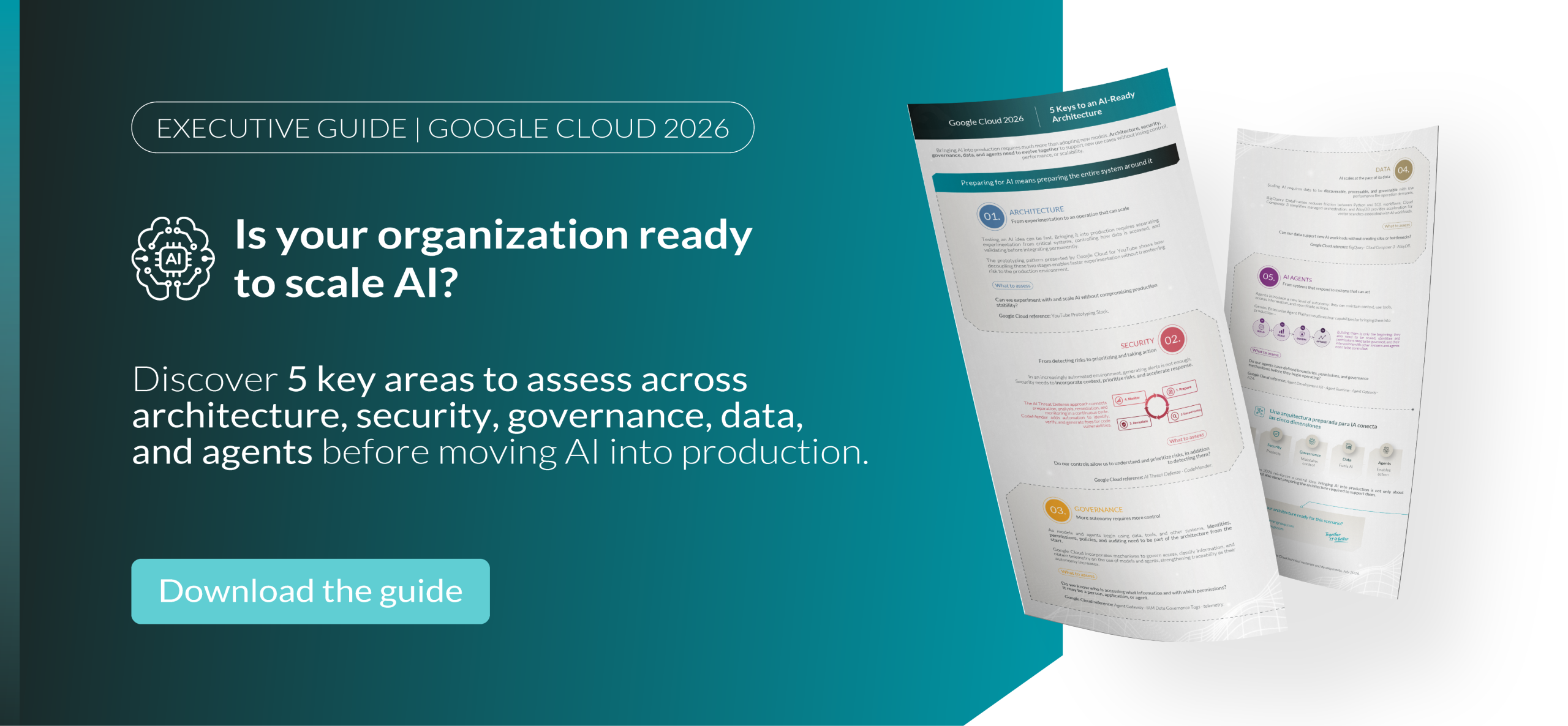

Image: Generated with ChatGPT Images 2.5, OpenAI, 2026.
Sources Consulted
- Google Cloud. (2026, 22 de octubre, última actualización). Auto data quality overview. Google Cloud Documentation. URL
- Sharma, V., & Sivakumar, D. (2026, 21 de julio). Supercharging pgvector: 4x faster HNSW vector search with AlloyDB. Google Cloud Blog. URL
- Swena, T. (2026, 16 de julio). Bridging the gap between SQL and Python with BigQuery and the %%bqsql magic. Google Cloud Blog. URL
- Wieczorek, P., & Hajný, J. (2026, 17 de septiembre). The future of orchestration: Pine59’s journey to Airflow 3 on Google Cloud. Google Cloud Blog. URL
Related articles

NEW ATTACK – REvil Ransomware
This weekend, an important Argentinean Corporation was hit by a ransomware attack and got their administrative operations impacted for several hours.
SAP on Azure to empower Enterprise IT Management
Optimize your business with a successful SAP on Azure integration. Discover here how to benefit from its scalability and security.