23 . 04 . 2026
Changes to SSL/TLS Certificates Validity: How to prepare
Find out what’s changing with the new SSL/TLS certificates validity periods, what the official timeline is, and why manual management is becoming an operational risk.
Table of contents
- What Changes with the New Validity Period for SSL/TLS Certificates
- Why SSL/TLS certificates validity periods are being shortened
- The real impact lies not in the standard itself, but in its implementation
- What risks arise if management remains manual
- Automation, monitoring, and governance: the new minimum standard
- What an organization should review today
- How Wezen Views This Situation
- FAQ about SSL/TLS certificates and the new validity period
- The new validity period for SSL/TLS certificates: a new operational requirement
Public SSL/TLS certificates will have a shorter maximum validity period starting in 2026. This change has already been established within the publicly trusted certificate ecosystem and requires organizations to review how they manage renewal, validation, monitoring, and operational continuity.
Until now, the standard maximum validity period for these types of certificates was 398 days. That limit has already begun to decrease and will continue to do so in stages over the coming years. In practice, this means more renewals, more frequent validations, and less margin to maintain manual management without increasing risk.
The key point is not only regulatory. The reduction in validity periods changes the level of operational demands. What could previously be handled with sporadic checks, spreadsheets, or isolated reminders now requires more structured processes, greater visibility, and a much clearer automation strategy.
For an IT leader, the question is no longer simply when a certificate expires. The question is whether the organization currently has the capacity to sustain shorter cycles without compromising continuity, control, or security.
What Changes with the New Validity Period for SSL/TLS Certificates
The change was approved by the CA/Browser Forum and applies to publicly trusted TLS certificates in the Web PKI ecosystem. This is not an optional or vendor-specific change: it is a mandatory international requirement.
The planned schedule gradually reduces the maximum validity period.
- From March 15, 2026, the limit was reduced to 200 days.
- From March 15, 2027, it will be reduced to 100 days.
- And from March 15, 2029, the maximum validity will be 47 days.
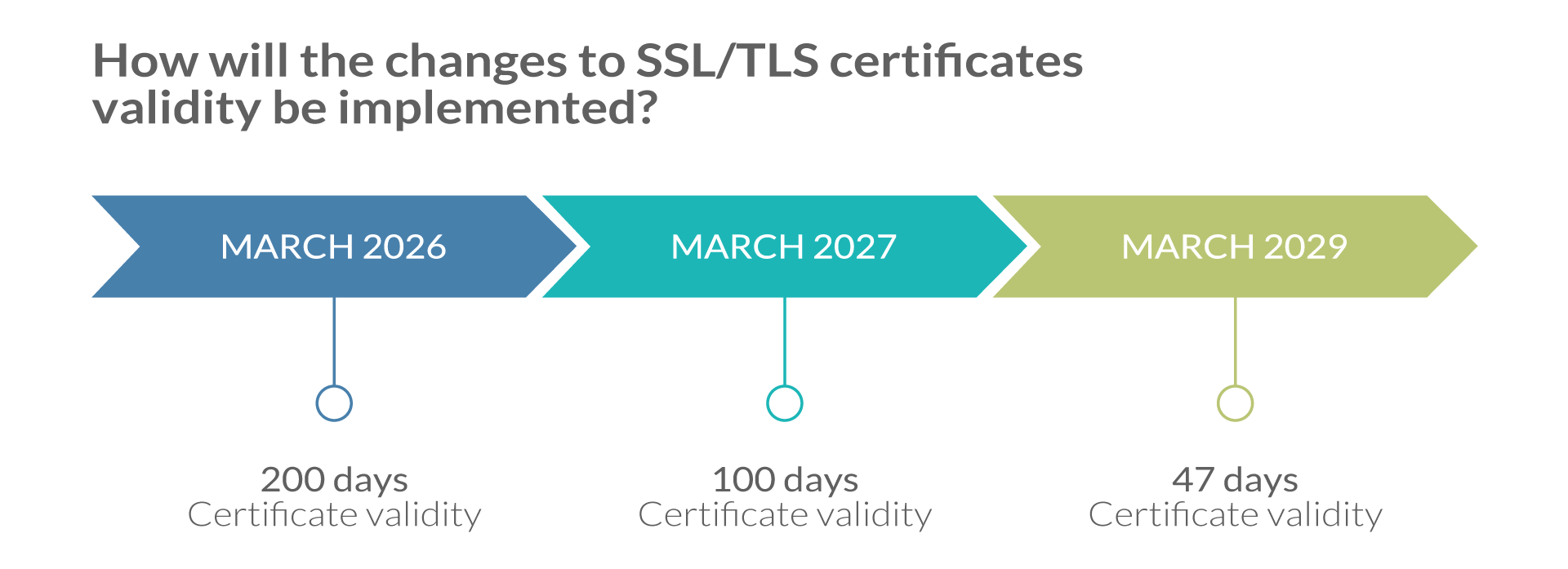
There is one point that needs to be clarified. Although the standard sets a maximum of 200 days for the first stage, some providers report an operational validity period of 199 days. This is not a contradiction, but rather a practical implementation designed to avoid exceeding the technical limit when calculating the certificate’s exact validity period.
In addition to the certificate’s duration, some validation renewal periods are also being shortened, particularly for domains and IPs included in the SAN. This adds an additional requirement: not only will renewals be needed more frequently, but validation processes will also need to be more agile and tightly controlled.
Why SSL/TLS certificates validity periods are being shortened
There are several reasons behind these changes:
Security and reliability of the ecosystem
Certificates with shorter validity periods help to:
- reduce exposure when a key is compromised,
- limit the impact of outdated information, and
- require validation checks to be performed more frequently.
The approved ballot also presents this transition as an explicit push toward better automation of the certificate lifecycle.
Operational optimization
There is also an underlying operational reason. As the digital environment grows in complexity, the ecosystem requires that the information associated with a certificate remain more up-to-date. A shorter validity period supports this goal and reduces the time during which an error, a misissuance, or outdated data can continue to have an effect.
Driving the automation of the certificate lifecycle
At the same time, this change pushes organizations toward better automation of the certificate lifecycle. Not as an optional trend, but as a practical response to a more demanding renewal and validation framework.
The real impact lies not in the standard itself, but in its implementation
From a technical perspective, the change can be summarized as a shorter validity period. From a business perspective, the impact is broader.
Every reduction in the validity period increases the frequency of tasks related to issuance, renewal, monitoring, and validation. In organizations with few domains or a simple infrastructure, the adjustment may seem minor. But the attack surface grows rapidly when the infrastructure is complex, such as in:
- environments with multiple services,
- applications,
- load balancers,
- APIs,
- hybrid environments, or
- distributed teams.
In this context, certificate management ceases to be a secondary administrative task. It becomes an operational capability that requires clear accountability, traceability, monitoring, and consistent processes.
Therefore, the problem is not just renewing more frequently. The problem is continuing to manage certificates as if the renewal frequency had no implications for operations.
When that happens, the likelihood of undetected expirations, late renewals, and loss of control over assets critical to digital trust increases.
What risks arise if management remains manual
As deadlines grow tighter, manual management begins to lose its effectiveness. The most obvious risk is the unexpected expiration of certificates that support exposed or critical websites, applications, or services. But that’s not the only one.
Outages, loss of trust, and increased operational burden
Sectigo and GlobalSign agree that expired or poorly managed certificates can lead to outages, loss of trust, and increased operational burden.
Reliance on repetitive tasks and informal reminders
There is also an increased reliance on repetitive tasks, informal reminders, and specific individuals who hold operational knowledge. This makes the process more fragile and harder to scale without errors.
Poor traceability
Another sensitive issue is traceability. Many organizations know they have active certificates, but they don’t always have a centralized inventory, a clear ownership structure, or complete visibility into which service depends on each certificate. With renewal cycles of 200, 100, or 47 days, this lack of organization ceases to be merely an inconvenience and begins to become a real source of risk.
The current process is unsustainable
Furthermore, the shortening of validation renewal cycles makes it necessary to assess whether the current process can be sustained more frequently and without friction. Receiving expiration alerts is not enough. We must also maintain control over which validations are still valid, which ones need to be renewed, and how to avoid bottlenecks as the pace increases.
Automation, monitoring, and governance: the new minimum standard
Given this scenario, the answer shouldn’t simply be to work faster. It should be to work with greater control.
Automation is gaining importance because it reduces manual tasks, lowers the probability of error, and sustains a higher renewal rate without relying on scattered interventions. But automation doesn’t just mean renewing certificates automatically. It also involves having visibility into the inventory, reliable monitoring, useful alerts, defined responsibilities, and well-organized validation processes.
From a strategic perspective, this ties into operational continuity. When the organization knows which certificates it has, where they are, which services they support, and how they are renewed, it can operate with less friction and less exposure.
That is why the conversation about SSL/TLS certificates should no longer be limited to purchase or expiration dates. It should be part of a broader framework of technology governance and reliable operations.
What an organization should review today
Before change becomes an urgent matter, it’s wise to ask the following questions:
- Is there a reliable inventory of public certificates and their expiration dates?
- Are there clearly defined points of contact for each service, domain, or environment?
- Does renewal still rely on manual tasks or isolated reminders?
- Can the validation process be sustained with shorter deadlines?
- Is the current infrastructure ready to move toward more automated management?
These questions may seem operational, but they actually reveal something deeper: the level of maturity with which a company manages a critical component of its security and digital continuity.
How Wezen Views This Situation
At Wezen, we see this change as a clear sign that certificate management needs to move away from a reactive approach.
When the validity period is shortened, it’s not just the expiration date that’s at stake. The organization’s operational maturity is also on the line. Its ability to monitor, validate, automate, and maintain an infrastructure ready to operate with less margin for error.
That is why this issue should not be addressed solely through one-off renewals. It should be reviewed as part of a broader strategy for operational control, governance, and continuity.
That is where a regulatory change ceases to be an external development and becomes an internal decision on how to better prepare operations.
FAQ about SSL/TLS certificates and the new validity period
Does the new validity period apply to all SSL/TLS certificates?
No. The change applies to publicly trusted TLS certificates in the Web PKI ecosystem. It should not be automatically applied to private or internal-use certificates.
What is the official effective date of the change?
The approved timeline for the ecosystem is March 15, 2026. Some providers adopted earlier implementation dates to roll out the new scheme. For example, DigiCert began implementing the measure on February 24, 2026.
Why do some providers mention 199 days and others 200?
Because the initial regulatory limit is 200 days, but some issuers work with 199 days to stay below the maximum technical limit.
Are certificates issued before the change still valid?
Yes. Certificates issued under the rule in effect at the time of issuance may remain valid until their normal expiration.
What else changes besides the certificate’s validity period?
Some validation data reuse periods are also reduced, particularly for domains and IPs, which requires more frequent revalidations.
The new validity period for SSL/TLS certificates: a new operational requirement
The new validity period for SSL/TLS certificates does not only change a timeframe. It raises the bar for operational requirements.
Starting in 2026, organizations working with public certificates will have to adapt to shorter cycles, more frequent validations, and less room to maintain manual processes without increasing risk.
In this context, the challenge is not merely renewing certificates on time. The challenge is having the necessary level of visibility, control, and governance to ensure operations remain reliable.
The opportunity lies in addressing this issue before the change leads to friction, overload, or preventable incidents. Check whether your current SSL/TLS certificates management is prepared to operate with shorter cycles without adding risk to your infrastructure. Write to us.

Image: generated by IA (DALL·E 3 – GPT-4o), OpenAI, 2026.
Sources consulted:
- CA/Browser Forum. (April 11, 2025). Ballot SC-081v3: Introduce schedule of reducing validity and data reuse periods. URL
- CA/Browser Forum. (December 15, 2025). Baseline Requirements for the Issuance and Management of Publicly-Trusted TLS Server Certificates (Version 2.2.0). URL
- DigiCert. (February 27, 2026). Moving to 199-day validity for public TLS certificates. URL
- DigiCert. (January 21, 2026). Domain validation reuse changes in 2026. URL
- GlobalSign. (August 1, 2025). A complete 47-day SSL/TLS certificate validity Q&A. URL
- Sectigo. (February 19, 2026). Certificate expiration risk: 200 day validity starts March 15. URL
- Sectigo. (February 6, 2026). Shorter validity periods for TLS certificates and domain validation reuse. URL
Related articles

WeSAP Monitoring Services
What differentiates a service of excellence in IT support contracts? When IT support is contracted, it is expected to meet [...]
What are the cybersecurity services a company needs?
Avoid loses, protect IT infrastructure and data from digital threats with cybersecurity services. Find out which ones are right for your company.